
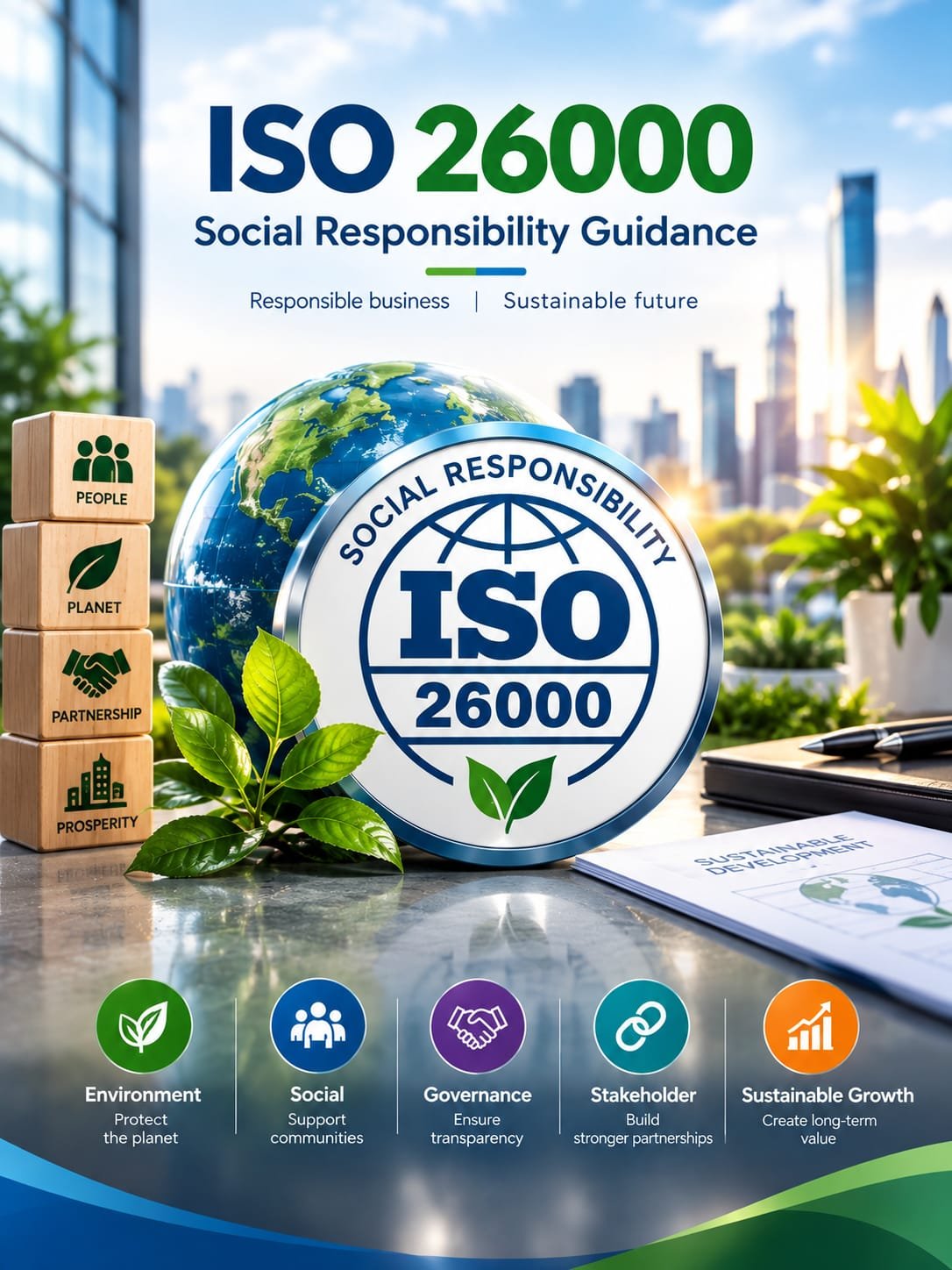
In the modern business world, success is no longer measured solely by financial performance.
Stakeholders, including customers, employees, governments, and investors, increasingly expect organizations to operate responsibly and ethically.
To meet these expectations, the International Organization for Standardization (ISO) developed ISO 26000, a global standard that provides guidance on social responsibility (SR).
Unlike other ISO standards, ISO 26000 is not a certifiable management system.
Instead, it offers voluntary guidance to help organizations integrate responsible practices into their operations, strategies, and culture.
This guide explores the origins, principles, key areas, benefits, challenges, and future role of ISO 26000 in promoting sustainable and ethical business conduct.
What is ISO 26000?
ISO 26000 is an international guidance standard that helps organizations of all types—businesses, governments, and non-profits—understand and implement social responsibility practices.
It provides a comprehensive framework for organizations to act ethically, contribute to sustainable development, and respect stakeholders’ interests.
Unlike certifiable standards such as ISO 9001 or ISO 14001, ISO 26000 is advisory in nature. Its goal is to encourage accountability, transparency, and ethical behavior across organizations rather than provide a certification.
Origins and Development of ISO 26000
ISO 26000 was officially published in 2010, following five years of collaboration among experts, governments, NGOs, industry representatives, and consumer groups worldwide.
The standard was developed in response to the increasing global demand for businesses and organizations to:
Contribute positively to society.
Protect human rights.
Promote ethical behavior.
Support sustainable development goals (SDGs).
Why ISO 26000 Matters Today
In today’s interconnected world, organizations face increasing pressure to go beyond profit-making and take responsibility for their social and environmental impact.
ISO 26000 plays a vital role by helping organizations:
Build trust with stakeholders through ethical and transparent operations.
Align with global sustainability initiatives, such as the United Nations Sustainable Development Goals (UN SDGs(.
Enhance long-term competitiveness by integrating responsibility into strategy.
Improve brand image and reputation as a socially responsible entity.
Core Principles of ISO 26000
ISO 26000 is built around seven guiding principles of social responsibility, which serve as the foundation for responsible business conduct:
1- Accountability – Taking responsibility for the organization’s actions and decisions.
2- Transparency – Being open and clear about decisions and their impacts.
3- Ethical Behavior – Acting with integrity and fairness.
4- Respect for Stakeholder Interests – Considering the needs and concerns of all parties affected.
5- Respect for the Rule of Law – Complying with legal requirements in all operations.
6- Respect for International Norms of Behavior – Aligning practices with global ethical standards.
7- Respect for Human Rights – Protecting and promoting human rights across operations and supply chains.
Core Subjects of ISO 26000
ISO 26000 provides guidance across seven core subjects, which organizations are encouraged to address:
- Organizational Governance – Ethical decision-making and accountability.
- Human Rights – Promoting and protecting human rights in all operations.
- Labor Practices – Ensuring fair labor policies, health, safety, and employee well-being.
- The Environment – Reducing negative environmental impacts and supporting sustainability.
- Fair Operating Practices – Fighting corruption and promoting ethical business conduct.
- Consumer Issues – Ensuring product safety, transparency, and fair treatment of customers.
- Community Involvement and Development – Contributing to the well-being and development of local communities.
Benefits of ISO 26000
Organizations that adopt ISO 26000 can experience significant advantages:
√ Enhanced Reputation and Trust
Acting responsibly strengthens brand reputation and fosters long-term customer loyalty.
√ Alignment with Global Standards
ISO 26000 aligns with the UN Sustainable Development Goals, enhancing credibility in global markets.
√ Improved Risk Management
Proactive responsibility reduces risks of reputational damage, lawsuits, and regulatory fines.
√ Increased Employee Engagement
Employees feel more motivated when working for organizations that value ethics and responsibility.
√ Competitive Advantage
Organizations that demonstrate strong social responsibility often stand out in tenders, partnerships, and investment opportunities.
Challenges in Implementing ISO 26000
While the benefits are significant, organizations may face challenges such as:
• Lack of Awareness – Many organizations are unfamiliar with ISO 26000 or its benefits.
• No Certification – Since it is not certifiable, some companies may find it less appealing compared to other ISO standards.
• Complexity of Integration – Implementing social responsibility across all areas requires cultural and operational change.
• Resource Limitations – Small businesses may struggle with resources for implementing SR initiatives.
ISO 26000 Across Different Sectors
One of ISO 26000’s strengths is its applicability across all industries and sectors:
⇒ Manufacturing – Encouraging sustainable production and fair labor practices.
⇒ Healthcare – Ensuring ethical treatment of patients and fair access to services.
⇒ Finance – Promoting transparency, fairness, and accountability.
⇒ Education – Supporting equal access, ethical teaching, and community involvement.
⇒Public Sector – Enhancing trust and accountability in government services.
ISO 26000 vs. Other Standards
ISO 9001 (Quality Management) – Focuses on product and service quality, while ISO 26000 emphasizes social responsibility.
ISO 14001 (Environmental Management) – Concentrates on environmental sustainability, which is only one aspect of ISO 26000.
ISO 37001 (Anti-Bribery) – Targets bribery prevention, whereas ISO 26000 covers broader ethical and social issues.
SA8000 (Social Accountability) – Similar to ISO 26000 but focuses more narrowly on labor rights.
The Future of ISO 26000
As global challenges like climate change, inequality, and human rights issues intensify, ISO 26000 will play an increasingly important role. Future trends may include:
Greater integration with ESG (Environmental, Social, Governance) frameworks.
Digital Responsibility – Addressing data ethics, cybersecurity, and AI transparency.
Stronger alignment with global sustainability goals and reporting requirements.
Wider adoption across small and medium enterprises (SMEs), not just large corporations.
FAQs about ISO 26000
1. Is ISO 26000 certifiable?
No, ISO 26000 is a guidance standard, not a certifiable management system.
2. Who can use ISO 26000?
Any organization—large or small, public or private—can apply its principles.
3. What is the cost of implementing ISO 26000?
There is no formal certification cost, but organizations may invest in training, reporting, and sustainability programs.
4. Can ISO 26000 be integrated with other ISO standards?
Yes, it complements standards like ISO 9001, ISO 14001, and ISO 37001.
Conclusion
ISO 26000 is more than just a guideline—it is a roadmap for ethical, transparent, and socially responsible business practices.
By adopting its principles, organizations can improve their reputation, strengthen stakeholder relationships, and contribute meaningfully to sustainable development.
Whether in manufacturing, healthcare, finance, or public service, ISO 26000 helps organizations go beyond compliance and embrace responsibility as a core value.
In a future where ethical and sustainable practices define long-term success, ISO 26000 stands as a powerful tool for organizations committed to making a positive impact on society and the planet.
Follow us on Facebook