Introduction to ISO 9001:2026 and the Importance of Quality Management
Quality management has become essential for organizations seeking sustainable growth, customer satisfaction, operational efficiency, and international competitiveness.
ISO 9001:2026 provides an internationally recognized framework that helps organizations establish, implement, maintain, and continually improve their Quality Management Systems.
Furthermore, the standard supports better decision-making, improved operational processes, risk management, and consistent delivery of products and services.
By implementing ISO 9001:2026, organizations can strengthen customer confidence, improve internal performance, and demonstrate their commitment to quality.
What Is ISO 9001:2026?
ISO 9001:2026 is an international standard specifying requirements for establishing and maintaining an effective Quality Management System (QMS).
It helps organizations consistently meet customer requirements, comply with applicable regulations, and improve overall organizational performance.
The standard applies to organizations of all sizes and industries, including manufacturing, construction, trading, healthcare, education, and service providers.
Its main purpose is to ensure that quality becomes an integral part of everyday business operations.
History and Development of ISO 9001
ISO 9001 has evolved through several revisions to reflect changing business environments and quality management practices.
1987: First publication of ISO 9001.
1994: Introduction of improvements to quality assurance requirements.
2000: Adoption of a process-based approach.
2008: Clarification and refinement of existing requirements.
2015: Introduction of risk-based thinking and the High-Level Structure.
2024: Climate change considerations added through an amendment.
2026: Publication of the latest revision of the Quality Management System standard.
Each revision aims to improve the relevance, clarity, and practical application of quality management requirements.
Objectives of ISO 9001:2026
– The main objectives of ISO 9001:2026 include:
– Improving customer satisfaction and confidence.
– Enhancing operational efficiency and productivity.
– Reducing errors, waste, and unnecessary costs.
– Improving risk and opportunity management.
– Strengthening leadership and organizational responsibility.
– Supporting continual improvement.
– Improving product and service consistency.
– Enhancing competitiveness in local and international markets.
Consequently, ISO 9001:2026 helps organizations build more effective and sustainable management systems.
The Seven Quality Management Principles
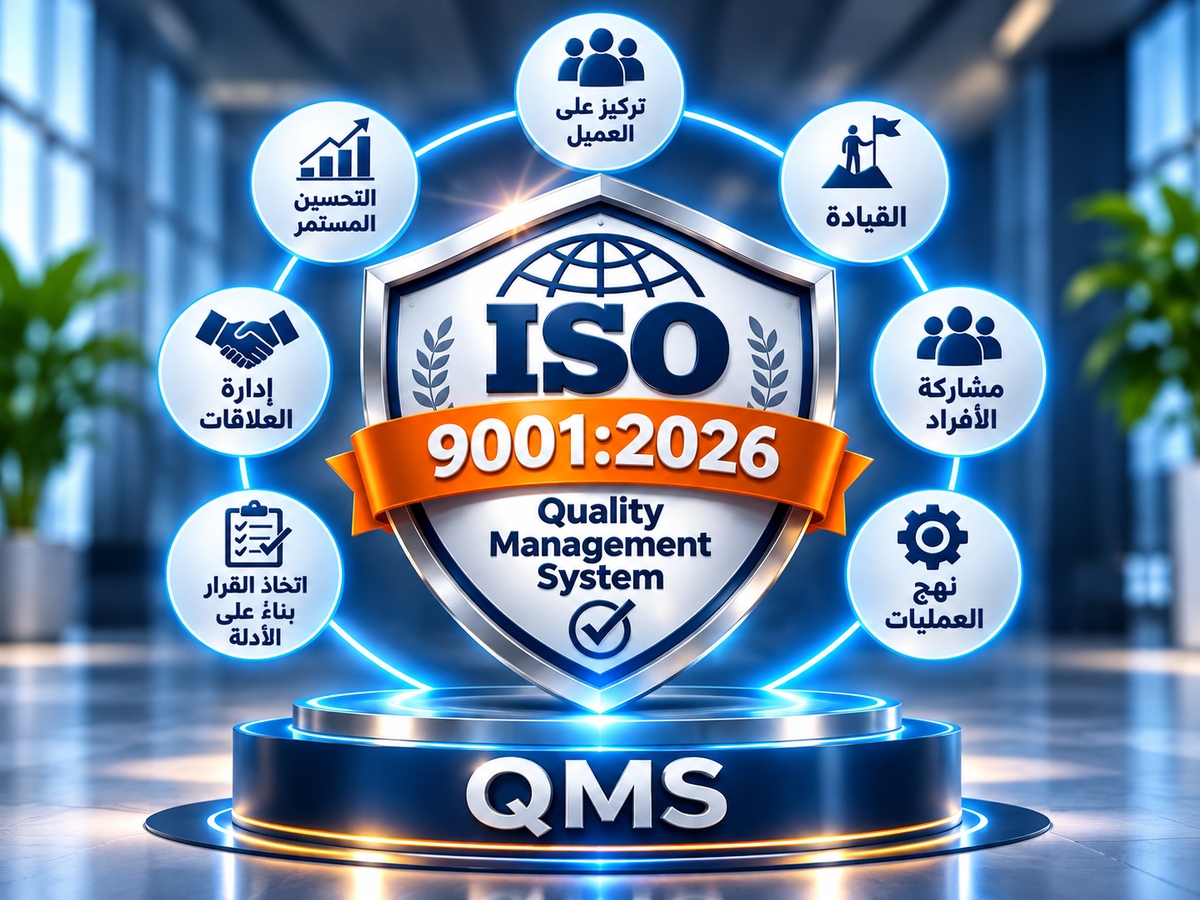
ISO 9001:2026 is based on seven fundamental Quality Management Principles.
- Customer Focus: Understanding customer needs and improving customer satisfaction.
- Leadership: Establishing clear direction and commitment throughout the organization.
- Engagement of People: Encouraging employee participation and professional development.
- Process Approach: Managing activities as interconnected processes.
- Improvement: Continually enhancing organizational performance.
- Evidence-Based Decision Making: Using reliable information and performance data.
- Relationship Management: Maintaining effective relationships with suppliers and interested parties.
These principles provide the foundation for an effective Quality Management System.
Structure of ISO 9001:2026
ISO 9001:2026 follows the harmonized structure used by international management system standards.
Its main clauses are:
– Clause 1: Scope.
– Clause 2: Normative References.
– Clause 3: Terms and Definitions.
– Clause 4: Context of the Organization.
– Clause 5: Leadership.
– Clause 6: Planning.
– Clause 7: Support.
– Clause 8: Operation.
– Clause 9: Performance Evaluation.
– Clause 10: Improvement.
Clauses 4 to 10 contain the main requirements organizations must address when implementing their Quality Management Systems.
Major Updates in ISO 9001:2026
The ISO 9001:2026 revision introduces improvements intended to clarify requirements and strengthen modern quality management practices.
Important areas include:
– Greater emphasis on quality culture.
– Stronger attention to ethical behaviour.
– Improved leadership responsibilities.
– Clarification of risk and opportunity management.Enhanced explanatory guidance.Updated harmonized management system structure.
– Continued consideration of climate change where relevant.
These developments help organizations integrate quality management more effectively into their business strategies and daily operations.
Detailed Explanation of ISO 9001:2026 Requirements
Clause 4: Context of the Organization
Organizations must identify internal and external factors affecting their objectives and Quality Management System.
They must also identify relevant interested parties, understand their requirements, determine the QMS scope, and identify necessary processes.
Clause 5: Leadership
Top management must demonstrate commitment to the Quality Management System and establish an effective quality policy.
Responsibilities include promoting customer focus, assigning authorities, supporting employees, and integrating quality objectives into business activities.
Clause 6: Planning
Organizations must identify risks and opportunities that could affect quality objectives and operational performance.
They must establish measurable quality objectives and plan appropriate actions, resources, responsibilities, and evaluation methods.
Clause 7: Support
This clause addresses resources, employee competence, infrastructure, workplace environment, organizational knowledge, communication, and documented information.
Organizations must ensure that employees have the necessary skills and resources to perform their responsibilities effectively.
Clause 8: Operation
Organizations must plan and control operational processes to ensure that products and services meet specified requirements.
This includes customer requirements, design and development where applicable, purchasing, production, service delivery, and control of nonconforming outputs.
Clause 9: Performance Evaluation
Organizations must monitor, measure, analyze, and evaluate the performance of their Quality Management Systems.
This includes customer satisfaction, internal audits, performance indicators, and management reviews.
Clause 10: Improvement
Organizations must identify improvement opportunities, control nonconformities, implement corrective actions, and continually improve their Quality Management Systems.
Difference Between ISO 9001:2015 and ISO 9001:2026
ISO 9001:2026 builds upon the established framework of ISO 9001:2015 while introducing clarifications and updated areas of emphasis.
The main developments concern quality culture, ethical behaviour, leadership, risk-based thinking, and explanatory guidance.
Organizations certified to ISO 9001:2015 should review their existing systems and identify the changes needed for transition.
They should update relevant procedures, provide employee awareness, conduct internal audits, and coordinate transition arrangements with their certification bodies.
How to Obtain ISO 9001:2026 Certification
Obtaining ISO 9001:2026 certification generally involves the following steps:
- Determine the certification scope and organizational activities.
- Select an appropriate certification body.
- Review the standard requirements.
- Conduct a gap analysis.
- Develop the Quality Management System.
- Prepare necessary documented information.
- Implement the system throughout the organization.
- Conduct internal audits.
- Perform management review.
- Complete the external certification audit.
- Address identified nonconformities.
- Receive the certification decision and certificate.
Successful certification requires evidence that the system is implemented and effective.
Requirements and Certification Bodies
Organizations must establish an effective Quality Management System covering their relevant activities and processes.
Essential requirements include a quality policy, measurable objectives, defined responsibilities, operational controls, documented information, internal audits, and management reviews.
ISO itself does not issue certificates. Certification is conducted by independent certification bodies.
Organizations should select certification bodies accredited by recognized accreditation bodies, with an appropriate ISO 9001 accreditation scope.
Examples include UKAS, ANAB, and EGAC, subject to verification of their current accreditation status and relevant scope.
Benefits of ISO 9001:2026 Certification
Implementing ISO 9001:2026 can provide significant organizational and commercial benefits.
Key benefits include:
– Increased customer satisfaction and confidence.
– Improved operational efficiency and productivity.
– Reduced operational errors and costs.
– Better supplier and process control.
– Improved employee awareness and responsibilities.
– Stronger organizational credibility.
– Enhanced opportunities in tenders and contracts.
– Improved competitiveness in international markets.
– Support for continual improvement.
The actual benefits depend on effective implementation rather than certification alone.
Which Organizations Need ISO 9001:2026?
ISO 9001:2026 is suitable for organizations across different sectors, regardless of size or ownership.
It can be implemented by:
– Manufacturing companies and factories.
– Construction and contracting companies.
– Trading, import, and export businesses.
– Transportation and logistics providers.
– Engineering and technical service companies.
– Hospitals and healthcare organizations.
– Educational institutions and training centers.
– Information technology and software companies.
– Maintenance and professional service providers.
– Small, medium, and large enterprises.
The standard can be adapted to different organizational structures and business activities.
Steps to Implement ISO 9001:2026
Successful implementation requires management commitment, employee participation, and a structured approach.
The main implementation stages include:
- Obtain top management commitment.
- Establish an implementation team.
- Identify organizational processes.
- Conduct a gap analysis.
- Develop the quality policy and objectives.
- Prepare necessary procedures and records.
- Train employees.
- Implement and monitor processes.
- Conduct internal audits.
- Perform management review.
- Prepare for external certification audits.
Organizations should focus on practical implementation rather than unnecessary documentation.
Required Documents and Records
ISO 9001:2026 requires organizations to maintain documented information necessary for effective system operation.
Depending on organizational activities, important documents and records may include:
– Quality Policy.
– Quality Objectives.
– QMS Scope.
– Process descriptions and responsibilities.
– Supplier evaluation records.
– Customer requirement records.
– Training and competence records.
– Inspection and testing records.
– Internal audit reports.
– Management review records.
– Nonconformity and corrective action records.
Documentation should remain appropriate to the organization’s size, complexity, and operational requirements.
Challenges and Preparation for ISO 9001:2026 Transition
Organizations may encounter several challenges when implementing or transitioning to ISO 9001:2026.
Common challenges include employee resistance, insufficient management commitment, limited awareness, weak documentation, and inadequate risk management.
To overcome these challenges, organizations should provide training, review existing procedures, strengthen leadership involvement, and improve internal communication.
Organizations certified to ISO 9001:2015 should conduct a transition gap analysis and coordinate with their certification bodies.
Early preparation helps reduce disruption and supports a smoother transition process.
Certification Process: From Application to Certificate
The certification process begins with submitting organizational information and defining the intended certification scope.
The certification body reviews the application, determines audit requirements, and arranges the certification assessment.
The process generally includes two audit stages:
Stage 1 Audit: Reviews documented information, organizational readiness, and the scope of the Quality Management System.
Stage 2 Audit: Evaluates actual implementation, operational controls, employee awareness, records, and conformity with requirements.
After reviewing the audit results and resolving applicable nonconformities, an authorized certification decision is made.
If approved, the organization receives its ISO 9001:2026 certificate.
19. How Long Does It Take to Obtain ISO 9001:2026 Certification?
The time required depends on organizational size, operational complexity, existing procedures, employee numbers, and system readiness.
Organizations with established processes may complete preparation faster than businesses starting from the beginning.
Implementation may take several weeks or months, depending on available resources and management commitment.
The external audit schedule also depends on the certification scope and applicable audit requirements.
Therefore, organizations should request an initial assessment to establish a realistic implementation and certification timeline.
Cost of ISO 9001:2026 Certification
There is no fixed certification price applicable to every organization.
The cost depends on several factors, including:
Number of employees.
Number of locations and branches.
Nature of business activities.
Complexity of operational processes.
Certification scope.
Existing QMS readiness.
Certification body and accreditation arrangements.
Audit duration and travel requirements.
Organizations should request a detailed quotation based on their actual activities, locations, and certification requirements.
Choosing a certification body based only on the lowest price is not recommended.
How to Verify an ISO 9001:2026 Certificate
Certificate verification is essential to establish authenticity and confirm the issuing certification body’s credentials.
Organizations and interested parties should check:
– Certified organization’s legal name.
– Certificate number.
– Certification scope.
– Covered locations.
– Issue and expiry dates.
– Certification body’s identity.
– Relevant accreditation status.
IAF CertSearch can help verify eligible accredited management system certifications where records are available.
If a certificate cannot be located, contact the certification body and relevant accreditation body for confirmation.
ISO itself does not issue certificates or maintain a comprehensive global register of all issued certificates.
Validity Period of ISO 9001:2026 Certification
An ISO 9001 certificate normally follows a three-year certification cycle, subject to applicable certification requirements.
During this period, surveillance audits are conducted to verify continued conformity and system effectiveness.
Before the certification cycle ends, a recertification audit is required to evaluate continued compliance.
Organizations must maintain their Quality Management Systems throughout the certification period.
Failure to meet applicable requirements may result in suspension or withdrawal of certification.
Frequently Asked Questions About ISO 9001:2026
1. What is ISO 9001:2026?
ISO 9001:2026 is an international standard specifying requirements for an effective Quality Management System.
2. What is the main purpose of ISO 9001:2026?
Its purpose is to improve customer satisfaction, operational performance, process consistency, and continual improvement.
3. Is ISO 9001:2026 suitable for small businesses?
Yes. It applies to organizations of all sizes and can be adapted to different operational requirements.
4. What are the main updates in ISO 9001:2026?
Key developments include greater attention to quality culture, ethical behaviour, leadership, and clarification of requirements.
5. Is ISO 9001:2015 still valid?
Existing certificates remain subject to applicable transition arrangements and deadlines established by the relevant accreditation framework.
6. How long does ISO 9001:2026 certification take?
The duration varies according to organizational size, system readiness, operational complexity, and audit arrangements.
7. How much does ISO 9001:2026 certification cost?
The price depends on employee numbers, locations, activities, certification scope, and audit requirements.
8. Does ISO issue ISO 9001 certificates?
No. Independent certification bodies conduct audits and issue certificates following an appropriate certification decision.
9. How long is an ISO 9001 certificate valid?
The normal certification cycle is three years, with periodic surveillance audits and subsequent recertification.
10. How can I verify an ISO 9001:2026 certificate?
Check the certificate details, issuing certification body, accreditation status, and available certification verification databases.
Conclusion
ISO 9001:2026 represents an important framework for organizations seeking better performance, stronger customer relationships, and sustainable business development.
By implementing an effective Quality Management System, organizations can improve operational efficiency, reduce errors, manage risks, and strengthen organizational credibility.
However, the true value of certification comes from practical implementation and continual improvement rather than obtaining a certificate alone.
Investing in ISO 9001:2026 means investing in customer confidence, operational excellence, and long-term business success.
ISO 9001:2026 – Make Quality Your Culture, Build Customer Confidence, and Create a Stronger Future for Your Business.